


Vertical Flight Society Award Recipients
Grover E. Bell Award
The Grover E. Bell Award is given for an outstanding research and experimentation contribution to the field of vertical flight development brought to fruition during the preceding 18 months. The Grover E. Bell Award was created by Larry Bell, founder of Bell Aircraft (now Bell Textron) in 1957, in honor of his pioneering older brother, Grover E. Bell, who was killed in an aircraft crash in 1913. Eligible contributions include sub-systems as well as systems. The award consists of a 3-inch gold medal bearing the profiles of Lawrence and Grover Bell, and a certificate.
2026
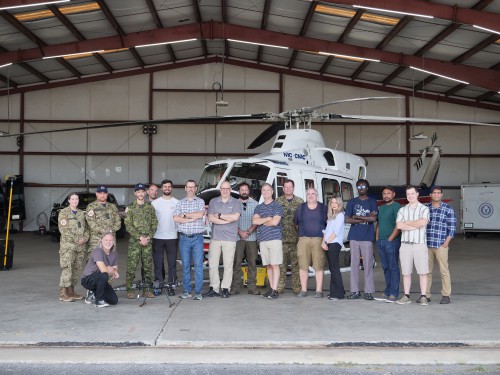
National Research Council of Canada’s AASCEND team
National Research Council of Canada
In a landmark achievement, the AASCEND team advanced full-scale rotorcraft autonomy by integrating an autonomous Bell 412 into a live military air assault exercise alongside crewed helicopters in degraded conditions—demonstrating supervised autonomy within an operational formation in non-segregated airspace. This breakthrough validates a scalable path for human-autonomy teaming and marks a significant step forward in autonomous vertical flight.
National Research Council of Canada
In a landmark achievement, the AASCEND team advanced full-scale rotorcraft autonomy by integrating an autonomous Bell 412 into a live military air assault exercise alongside crewed helicopters in degraded conditions—demonstrating supervised autonomy within an operational formation in non-segregated airspace. This breakthrough validates a scalable path for human-autonomy teaming and marks a significant step forward in autonomous vertical flight.
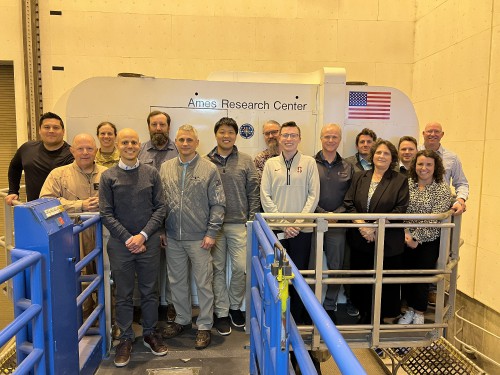
DEVCOM Aviation & Missile Center ARCTIC Team
US Army DEVCOM AvMC
The ARCTIC team is recognized for advancing high-fidelity rotorcraft research through ARCTIC-6, where advanced autonomy—real-time path planning, obstacle avoidance, and safe landing selection—was integrated into a full-motion simulation of next-generation tiltrotor aircraft within dynamic threat environments. This achievement enabled realistic evaluation of autonomous operations in complex scenarios, reducing risk for future flight testing and accelerating next-generation vertical lift capabilities.
US Army DEVCOM AvMC
The ARCTIC team is recognized for advancing high-fidelity rotorcraft research through ARCTIC-6, where advanced autonomy—real-time path planning, obstacle avoidance, and safe landing selection—was integrated into a full-motion simulation of next-generation tiltrotor aircraft within dynamic threat environments. This achievement enabled realistic evaluation of autonomous operations in complex scenarios, reducing risk for future flight testing and accelerating next-generation vertical lift capabilities.
2025
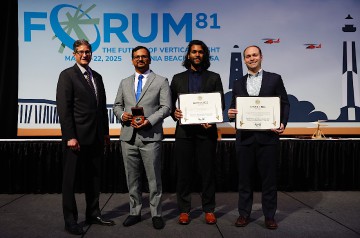
Rapid Wildfire Response Demonstration Team
Sikorsky, a Lockheed Martin Company, and Rain
For executing the first fully autonomous aerial firefighting mission. By integrating Sikorsky’s autonomous Black Hawk with Rain’s wildfire detection system, the team enabled rapid, precise, and around-the-clock wildfire suppression, advancing the future of autonomous fire response.
Sikorsky, a Lockheed Martin Company, and Rain
For executing the first fully autonomous aerial firefighting mission. By integrating Sikorsky’s autonomous Black Hawk with Rain’s wildfire detection system, the team enabled rapid, precise, and around-the-clock wildfire suppression, advancing the future of autonomous fire response.
2024
Tiltrotor Aeroelastic Stability Testbed (TRAST) Wind Tunnel Test Team
US Army Research Lab (ARL), DEVCOM AvMC and NASA
The tests conducted by the TRAST Team demonstrated the effects of a wide range of tiltrotor design parameters on aeroelastic stability, including blade flap-pitch (delta-3) angles, blade structural properties, gimbal hub damping and stiffness, pylon yaw stiffness, and pylon pitch stiffness.
US Army Research Lab (ARL), DEVCOM AvMC and NASA
The tests conducted by the TRAST Team demonstrated the effects of a wide range of tiltrotor design parameters on aeroelastic stability, including blade flap-pitch (delta-3) angles, blade structural properties, gimbal hub damping and stiffness, pylon yaw stiffness, and pylon pitch stiffness.

2023
Autonomous Sustainment Technologies for Rotorcraft Operations (ASTO) Rotor Team
For their experimental contribution to the development and test demonstrations of technologies for automated in-flight rotor track and balance (RTB).
For their experimental contribution to the development and test demonstrations of technologies for automated in-flight rotor track and balance (RTB).

2022
Project Convergence 2021 Autonomy Demonstration with a S-70 Optionally Piloted Vehicle (OPV) - Sikorsky
Sikorsky, a Lockheed Martin Company
Several firsts were achieved in this project demonstration, including multiple autonomous re-supply missions, including autonomous aircraft startup, pre-flight checks, flight and shutdown; launch of uncrewed air launched effects (ALEs) from the OPV that was itself acting as a drone; first autonomous Black Hawk commanded by soldiers; first time a Black Hawk helicopter has been commanded off-board via an operational Army Ground Control Station (ATAK tablet).
Sikorsky, a Lockheed Martin Company
Several firsts were achieved in this project demonstration, including multiple autonomous re-supply missions, including autonomous aircraft startup, pre-flight checks, flight and shutdown; launch of uncrewed air launched effects (ALEs) from the OPV that was itself acting as a drone; first autonomous Black Hawk commanded by soldiers; first time a Black Hawk helicopter has been commanded off-board via an operational Army Ground Control Station (ATAK tablet).

2021
Bell's Electrically Distributed Anti-Torque (EDAT) Development Program
Bell Textron
This year's recipient Bell’s EDAT is a distributed anti-torque thrust system, using an array of electric fans with fixed-pitch blades. This concept offers greater simplicity than conventional designs and has the potential to reduce helicopter noise.
Bell Textron
This year's recipient Bell’s EDAT is a distributed anti-torque thrust system, using an array of electric fans with fixed-pitch blades. This concept offers greater simplicity than conventional designs and has the potential to reduce helicopter noise.

2020
Sikorsky-Boeing/Army Joint Multi-Role Test Team
Sikorsky-Boeing
This year’s Grover E. Bell Award recipient is the Sikorsky-Boeing/Army Joint Multi-Role Test Team.
Sikorsky-Boeing
This year’s Grover E. Bell Award recipient is the Sikorsky-Boeing/Army Joint Multi-Role Test Team.

2019
Bell V-280 Valor Team
US Army Aviation Development Directorate and Bell
This year’s recipient was the Bell V-280 Valor Team. Over the first year of flying, the team generated over 1,000 flight test points, gathering critical data on the performance and characteristics of a clean-sheet design rotorcraft. During more than 90 hours of flight testing, the fly-by-wire V-280 demonstrated forward flight at 280 knots (518 km/h) true airspeed, as well as low and high-speed agility.
US Army Aviation Development Directorate and Bell
This year’s recipient was the Bell V-280 Valor Team. Over the first year of flying, the team generated over 1,000 flight test points, gathering critical data on the performance and characteristics of a clean-sheet design rotorcraft. During more than 90 hours of flight testing, the fly-by-wire V-280 demonstrated forward flight at 280 knots (518 km/h) true airspeed, as well as low and high-speed agility.

2018
Clean Sky Green Rotorcraft (GRC) Rotor Design Team
Airbus Helicopters
In just 30 months, the five-nation Airbus team developed, built and flight tested a five-bladed passive rotor optimized for acoustics, performance, comfort and cost.
Airbus Helicopters
In just 30 months, the five-nation Airbus team developed, built and flight tested a five-bladed passive rotor optimized for acoustics, performance, comfort and cost.

2017
AW189 FIPS Interdisciplinary Team
Leonardo Helicopters
For the programs rapid prototype development, application and certification of the AW189 Full Ice Protection System (FIPS).
Leonardo Helicopters
For the programs rapid prototype development, application and certification of the AW189 Full Ice Protection System (FIPS).

2016
The Sikorsky S-97 Raider First Flight Team
Sikorsky Aircraft Corporation
For the successful industry-funded, rapid-prototyping design and development of an entirely new configuration, moving from conceptual design to flight in less than five years.
Sikorsky Aircraft Corporation
For the successful industry-funded, rapid-prototyping design and development of an entirely new configuration, moving from conceptual design to flight in less than five years.

2015
Hub Mounted Vibration Suppression Design and Test Team
Sikorsky, AATD, and LORD
The team successfully demonstrated the ability of the HMVS to provide enhanced vibration suppression with significantly less weight, paving the way for a jet-smooth ride on both legacy and future aircraft with active rotor control
Sikorsky, AATD, and LORD
The team successfully demonstrated the ability of the HMVS to provide enhanced vibration suppression with significantly less weight, paving the way for a jet-smooth ride on both legacy and future aircraft with active rotor control

2014
Project Zero Team
AgustaWestland
The team successfully designed, built, and flew a highly innovative, one-ton, all-electric vertical flight aircraft in six months that established many world firsts, and worked as a lean and highly agile integrated team of 16 companies across three continents
AgustaWestland
The team successfully designed, built, and flew a highly innovative, one-ton, all-electric vertical flight aircraft in six months that established many world firsts, and worked as a lean and highly agile integrated team of 16 companies across three continents

2013
Armed Scout Helicopter/Aerodynamics Improvement Team
AMRDEC/NASA/PM
The team conceived, developed, tested and analyzed a powered scale model of the emerging OH-58F Kiowa Warrior configuration. The model is perhaps the most detailed scale wind-tunnel helicopter with full aerodynamic simulation of external components ever tested
AMRDEC/NASA/PM
The team conceived, developed, tested and analyzed a powered scale model of the emerging OH-58F Kiowa Warrior configuration. The model is perhaps the most detailed scale wind-tunnel helicopter with full aerodynamic simulation of external components ever tested

2012
Apache Block III Technology Development Team AH-64D
The Boeing Company
For successfully developing the AH-64D Block III technical improvements, including Level IV Manned Unmanned Teaming, Open System Avionics architecture and significantly improved air vehicle operating performance due to the new split torque, face gear main transmission design and the new composite main rotor blades (CMRB)
The Boeing Company
For successfully developing the AH-64D Block III technical improvements, including Level IV Manned Unmanned Teaming, Open System Avionics architecture and significantly improved air vehicle operating performance due to the new split torque, face gear main transmission design and the new composite main rotor blades (CMRB)

2011
UH-60 Airloads Wind Tunnel Test Team
US Army, US Air Force, NASA, and The National Full-Scale Aerodynamics Complex(NFAC)
For successfully completing the most intricate and extensive testing ever performed on a full-scale rotor system.
US Army, US Air Force, NASA, and The National Full-Scale Aerodynamics Complex(NFAC)
For successfully completing the most intricate and extensive testing ever performed on a full-scale rotor system.

2010
3D-LZ Team
Engineers and pilots
US Air Force, H.N. Burns Engineering Corporation, the US Army, the US Marine Corps, L-3 Vertex, the University of California at Santa Cruz, and Infoscitex
The team assimilated and tested the various 3D-LZ system components on the test helicopter, and then performed a safe and thorough assessment of the technology in complete brown-out conditions.
Engineers and pilots
US Air Force, H.N. Burns Engineering Corporation, the US Army, the US Marine Corps, L-3 Vertex, the University of California at Santa Cruz, and Infoscitex
The team assimilated and tested the various 3D-LZ system components on the test helicopter, and then performed a safe and thorough assessment of the technology in complete brown-out conditions.

2009
National Full-Scale Aerodynamics Complex (NFAC) Team
US Air Force/Arnold Engineering Development Center
The team succeeded in restoring the NFAC to full operational status for rotorcraft testing in 2008. The NFAC is the 40-by-80 Foot, 80-by-120 Foot large-scale wind tunnel located at NASA Ames Center at Moffett Field, California.
US Air Force/Arnold Engineering Development Center
The team succeeded in restoring the NFAC to full operational status for rotorcraft testing in 2008. The NFAC is the 40-by-80 Foot, 80-by-120 Foot large-scale wind tunnel located at NASA Ames Center at Moffett Field, California.

2008
UH-60M Upgrade Flight Control Team
US Army, NASA, and Sikorsky Aircraft Corp.
This year's honored recipient is the US Army / NASA / Sikorsky UH-60M Upgrade Flight Control Team. The team defined, developed and built the most advanced helicopter flight control system flying today establishing full-authority, fly-by-wire control performance with active collective and cyclic inceptors.
US Army, NASA, and Sikorsky Aircraft Corp.
This year's honored recipient is the US Army / NASA / Sikorsky UH-60M Upgrade Flight Control Team. The team defined, developed and built the most advanced helicopter flight control system flying today establishing full-authority, fly-by-wire control performance with active collective and cyclic inceptors.

2007
Manned/Unmanned Common Architecture Program, Phase II (MCAP II) Team
US Army AATD; The Boeing Company; and EFW, Inc.
The advances demonstrated by the MCAP II team reduce the cost of maintaining and updating helicopter avionics systems while enabling helicopter platforms to become full participants in network centric operations on the modern asymmetric battlefield.
US Army AATD; The Boeing Company; and EFW, Inc.
The advances demonstrated by the MCAP II team reduce the cost of maintaining and updating helicopter avionics systems while enabling helicopter platforms to become full participants in network centric operations on the modern asymmetric battlefield.

2006
Dr. Valentin Kloeppel
Aeromechanics Program Manager
Eurocopter Deutchland GmbH
Dr. Kloeppel's work in Active Rotor Control of helicopter blades, first on Higher Harmonic Control then on Individual Blade Control, led on September 8, 2005 to the world's first flight of a full-scale helicopter with electrically driven flaps. This work will result in reduced vibration, exterior noise, dynamic loads, blade instabilities, shocks and stall.
Aeromechanics Program Manager
Eurocopter Deutchland GmbH
Dr. Kloeppel's work in Active Rotor Control of helicopter blades, first on Higher Harmonic Control then on Individual Blade Control, led on September 8, 2005 to the world's first flight of a full-scale helicopter with electrically driven flaps. This work will result in reduced vibration, exterior noise, dynamic loads, blade instabilities, shocks and stall.

2005
Unmanned Little Bird Team
The Boeing Company
The team converted a commercial helicopter into an autonomous demonstrator capable of automatic take-offs and landings as well as autonomous waypoint navigation.
The Boeing Company
The team converted a commercial helicopter into an autonomous demonstrator capable of automatic take-offs and landings as well as autonomous waypoint navigation.

2004
MV-22 Integrated Test Team
Bell Helicopter Textron, Inc., DynCorp, NAVAIR, Rolls-Royce, The Boeing Company and US Marine Corps.
Bell Helicopter Textron, Inc., DynCorp, NAVAIR, Rolls-Royce, The Boeing Company and US Marine Corps.

2003
Flight Research Laboratory
National Research Council of Canada
For conducting world class vertical takeoff and landing research since the 1950s.
National Research Council of Canada
For conducting world class vertical takeoff and landing research since the 1950s.

2002
Alfred Gessow Rotorcraft Center
University of Maryland
Award was accepted by Dr. Inderjit Chopra, Director of the Alfred Gessow Rotorcraft Center, Elaine Gessow, wife of the late Professor Gessow and his daughter Lisa Michaelson.
University of Maryland
Award was accepted by Dr. Inderjit Chopra, Director of the Alfred Gessow Rotorcraft Center, Elaine Gessow, wife of the late Professor Gessow and his daughter Lisa Michaelson.

2001
Bell/NASA/US Army Multipoint Adaptive Vibration Suppression Systems (MAVSS) Team
Bell Helicopter Textron, Inc., NASA and US Army
For their successful development and demonstration of the MAVSS controller on the V-22 tiltrotor aircraft.
Bell Helicopter Textron, Inc., NASA and US Army
For their successful development and demonstration of the MAVSS controller on the V-22 tiltrotor aircraft.

2000
Rotorcraft Pilot's Associate Team
US Army, Boeing Mesa, Lockheed Martin Federal Systems, Lockheed Martin Advanced Technology Laboratories, Applied Systems Intelligence and Honeywell
For their successful development and demonstration of the world's first cognitive decision aiding system for combat helicopters.
US Army, Boeing Mesa, Lockheed Martin Federal Systems, Lockheed Martin Advanced Technology Laboratories, Applied Systems Intelligence and Honeywell
For their successful development and demonstration of the world's first cognitive decision aiding system for combat helicopters.

1999
Tiltrotor Aero-Acoustical Model Team
1998
Health and Usage Monitoring System Team
For research and experimentation in helicopter development.
For research and experimentation in helicopter development.

1997
Longbow Apache Team
US Army/McDonnell Douglas Helicopter Systems
For one of the most successful flight test programs ever conducted on Army systems.
US Army/McDonnell Douglas Helicopter Systems
For one of the most successful flight test programs ever conducted on Army systems.

1996
Ducted Tail Rotor Team
Bell Helicopter
For their outstanding design which will improve safety, increase aerodynamic efficiency and reduce noise.
Bell Helicopter
For their outstanding design which will improve safety, increase aerodynamic efficiency and reduce noise.

1995
UH-60 Airloads Program
US Army, Aeroflightdynamics Directorate, and NASA Ames
For outstanding cooperative research and development on UH-60 Airloads Program.
US Army, Aeroflightdynamics Directorate, and NASA Ames
For outstanding cooperative research and development on UH-60 Airloads Program.

1994
Full Scale Aerodynamics Complex
NASA
For their outstanding cooperative research and development support.
NASA
For their outstanding cooperative research and development support.

1993
Frederic Schmitz
NASA
Honored for the work performed by the NASA Full Scale Aerodynamics Complex.
NASA
Honored for the work performed by the NASA Full Scale Aerodynamics Complex.
1992
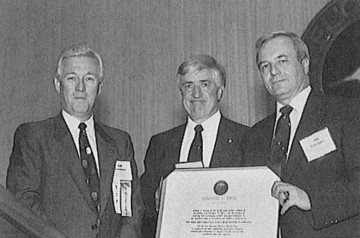
George T. Singley, III and the
US Army Rotorcraft Centers of
Excellence
Georgia Institute of Technology, University of Maryland, Rensselaer Polytechnic Institute.
Georgia Institute of Technology, University of Maryland, Rensselaer Polytechnic Institute.
1991
4BW Team
Bell Helicopter Textron
4BW Team successfully completed flight tests of an all-composite four-bladed bearingless main rotor on an AH- I W Cobra helicopter.
Bell Helicopter Textron
4BW Team successfully completed flight tests of an all-composite four-bladed bearingless main rotor on an AH- I W Cobra helicopter.

1990
No Award Presented
1989
UTC 'Shadow' Team
Sikorsky Aircraft
Sikorsky Aircraft

1988
Sikorsky Aircraft Team - Div. UTC and Systems Technology, Inc.
Sikorsky Aircraft
The Grover E. Bell Award was presented to the team of Sikorsky Aircraft, Div. UTC, and Systems Technology, Inc., for their contributions to helicopter development, research and experimentation advancing the modeling and testing of helicopter dynamics and structural bending modes.
Sikorsky Aircraft
The Grover E. Bell Award was presented to the team of Sikorsky Aircraft, Div. UTC, and Systems Technology, Inc., for their contributions to helicopter development, research and experimentation advancing the modeling and testing of helicopter dynamics and structural bending modes.
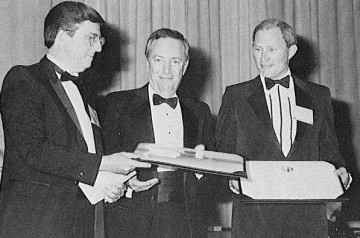
1987
Boeing Vertol Company, US Army Applied Technology Directorate
The Grover E. Bell Award was shared jointly by Boeing Vertol and the U.S. Army Applied Technology Directorate.
The Grover E. Bell Award was shared jointly by Boeing Vertol and the U.S. Army Applied Technology Directorate.

1986
Franklin D. Harris
Bell Helicopter Textron
Grover E. Bell award winner Franklin D. Harris, Bell Helicopter Textron, was recognized for his efforts as the director of engineering for the Army Helicopter Improvement Program.
Bell Helicopter Textron
Grover E. Bell award winner Franklin D. Harris, Bell Helicopter Textron, was recognized for his efforts as the director of engineering for the Army Helicopter Improvement Program.

1985
Applied Technology Laboratories and ACAP Team
US Army, Sikorsky Aircraft
In recognition of outstanding research and experimentation in helicopter development.
US Army, Sikorsky Aircraft
In recognition of outstanding research and experimentation in helicopter development.
1984
Applied Technology Laboratory, Ft. Eustis
US Army -ATL
For its role in supporting helicopter research and development.
US Army -ATL
For its role in supporting helicopter research and development.

1983
Simulation Lab
Bruce B Blake, and Theodore S. Garnett, Jr.
Boeing Vertol
For their efforts as the leaders of the Boeing Vertol Simulation Laboratory's contribution to the advancement of simulation technology.
Boeing Vertol
For their efforts as the leaders of the Boeing Vertol Simulation Laboratory's contribution to the advancement of simulation technology.

1982
Dr. Wayne R. Johnson
Group Leader- Low-Speed Aircraft Research Branch
NASA Ames
He made major contributions to the solution of specific problems such as tilt rotor dynamics, ground resonance on wind tunnel strut systems, influence of rotor wake geometry on blade loads, dynamics of large wing turbines, and rotrcraft noise generation.
Group Leader- Low-Speed Aircraft Research Branch
NASA Ames
He made major contributions to the solution of specific problems such as tilt rotor dynamics, ground resonance on wind tunnel strut systems, influence of rotor wake geometry on blade loads, dynamics of large wing turbines, and rotrcraft noise generation.

1981
U.S.Army/NASA/Bell Helicopter Textron XV-15 Project Team
In recognition of its outstanding achievement in successfully demonstrating the feasibility and potential of tilt rotor technology. This highly successful program has been an achievement of innovative management and engineering and a model of cooperation between government and contractor representatives in all the various testing activities.
In recognition of its outstanding achievement in successfully demonstrating the feasibility and potential of tilt rotor technology. This highly successful program has been an achievement of innovative management and engineering and a model of cooperation between government and contractor representatives in all the various testing activities.
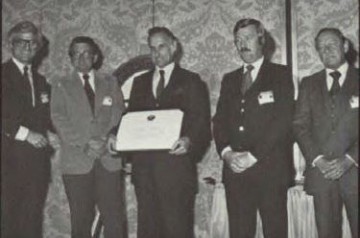
1980
No Award Presented
1979
Wesley L. Cresap

1978
AH-64 Tech. Team and Sikorsky Aircraft H-60 Tech. Team
Hughes Helicopters and Sikorsky Aircraft
For outstanding improvements representing exceptional innovation on the part of the design teams to provide the free world combat helicopters with substantial reductions in vulnerability and improved safety features which are the key to the survivability of their military user.
Hughes Helicopters and Sikorsky Aircraft
For outstanding improvements representing exceptional innovation on the part of the design teams to provide the free world combat helicopters with substantial reductions in vulnerability and improved safety features which are the key to the survivability of their military user.

1977
Aviation Engineering Flight Activity
US Army
For the development under unusually severe constrictions of time and equipment of many exemplary experimentation techniques, and for generating data vital to successful on-time completion of competitive tests involving the UTTAS and AAH Programs in support of the source-selection process.
US Army
For the development under unusually severe constrictions of time and equipment of many exemplary experimentation techniques, and for generating data vital to successful on-time completion of competitive tests involving the UTTAS and AAH Programs in support of the source-selection process.

1976
ABC Team
Sikorsky Aircraft Div. of United Technologies Corp.
For the development of the advancing blade concept research helicopter. The success of this concept opens the potential of applying lifting rotors to much higher speeds and load factors than has been heretofore possible.
Sikorsky Aircraft Div. of United Technologies Corp.
For the development of the advancing blade concept research helicopter. The success of this concept opens the potential of applying lifting rotors to much higher speeds and load factors than has been heretofore possible.
1975
Thomas H. Sanders
Manager-HLH
Boeing Vertol Co.
For development of the HLH Fly-by-Wire Control system, wit full recognition to Ralph Trueblood of Charles Stark Draper Laboratory, and James Matthews of AcLabs for prior work in this area.
Manager-HLH
Boeing Vertol Co.
For development of the HLH Fly-by-Wire Control system, wit full recognition to Ralph Trueblood of Charles Stark Draper Laboratory, and James Matthews of AcLabs for prior work in this area.

1974
No Award Presented
1973
Jan Drees
Bell Helicopter Co.
For development of the nodalized beam concept for reducing helicopter vibration.
Bell Helicopter Co.
For development of the nodalized beam concept for reducing helicopter vibration.

1972
Aircraft Division, Engineering Team
The Hughes Tool Company
For development of the world's quietest helicopter.
The Hughes Tool Company
For development of the world's quietest helicopter.

The Boeing/Vertol Model 347 Team
Boeing
For developing new standards in helicopter flying qualities, vibration and noise.
Boeing
For developing new standards in helicopter flying qualities, vibration and noise.

1971
S-67 Black Hawk Advance Fire Support Team
Sikorsky Aircraft
Sikorsky Aircraft

1970
AVLABS
US Army
For research and development during 1969 leading toward the development of advanced helicopters.
US Army
For research and development during 1969 leading toward the development of advanced helicopters.

1969
Sikorsky Aircraft
For successful development and demonstration, thereby proving the utility and practicality of the flying crane concept by company sponsored efforts.
For successful development and demonstration, thereby proving the utility and practicality of the flying crane concept by company sponsored efforts.

1968
Edwin J. Ducayet, HUEY/COBRA Team
Sikorsky Aircraft
For the successful and timely development of an attack helicopter for the escort and direct aerial fire support roles.
Sikorsky Aircraft
For the successful and timely development of an attack helicopter for the escort and direct aerial fire support roles.

1967
Air Rescue and Recovery Service
Military Airlift Command
US Air Force
For conceiving and fostering operational in-flight refueling of helicopters from standard tanker aircraft, thereby increasing effective helicopter ranges to the limits of crew capability.
US Air Force
For conceiving and fostering operational in-flight refueling of helicopters from standard tanker aircraft, thereby increasing effective helicopter ranges to the limits of crew capability.

1966
Paul J. Carpenter
Director of Systems
USA Aviation Materiel Laboratory
For his foresight and leadership in fostering and directing research which established the technical feasibility of high-speed helicopter flight.
Director of Systems
USA Aviation Materiel Laboratory
For his foresight and leadership in fostering and directing research which established the technical feasibility of high-speed helicopter flight.

1965
No Award Presented
1964
No Award Presented
1963
US Army 11th Air Assault Division, Ft. Benning
11th Air Assault Division, Ft. Benning
US Army
11th Air Assault Division, Ft. Benning
US Army
1962
Sikorsky Aircraft Engineering Team
Sikorsky Aircraft
For development of the HSS-2 which claimed four world speed records for the United States.
Sikorsky Aircraft
For development of the HSS-2 which claimed four world speed records for the United States.
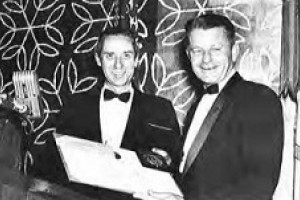
1961
Combat Development Office of US Army Aviation School
US Army Aviation School
For its outstanding work in the field of helicopter development. For the development of the helicopter as a close air support combat vehicle, thereby significantly increasing its military effectiveness. The award presented to Major General Ernest F. Easterbrook, Commander of Army Aviation Center.
US Army Aviation School
For its outstanding work in the field of helicopter development. For the development of the helicopter as a close air support combat vehicle, thereby significantly increasing its military effectiveness. The award presented to Major General Ernest F. Easterbrook, Commander of Army Aviation Center.

1960
Igor I. Sikorsky
For his outstanding pioneering work in the development of the crane helicopter.
For his outstanding pioneering work in the development of the crane helicopter.
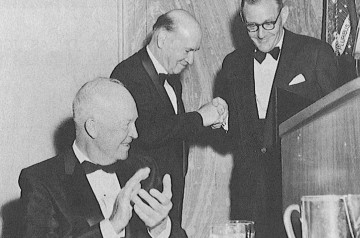
1959
Vertol Engineering Staff
Vertol Aircraft Company
For design, development and successful test flight of the Vertol 76, the first tilt wing aircraft to perform successful conversion.
Vertol Aircraft Company
For design, development and successful test flight of the Vertol 76, the first tilt wing aircraft to perform successful conversion.

1958
Leon L. Douglas
1957
Kurt H. Hohenemser
Cached October 13, 2026 9:07:07 AM CDT